
NO Gas Import Terminals in Corio Bay or Port Phillip Bay
They are back at it again.
We campaigned hard against Viva Energy’s Gas Import Terminal, but now we have yet another big corporation attempting to build a Gas Import Terminal in Port Phillip Bay. Our community has repeatedly said NO to Gas Import Terminals, so let's make our voices loud and clear once again!
What is Vopak’s Gas Import Terminal Proposal?
The Vopak Victoria Energy Terminal is a proposed liquefied natural gas (LNG) import terminal planned for Port Phillip Bay. The project would receive LNG from overseas, store it, convert it back into gas (regasify it), and feed it into Victoria’s existing gas network.
This means large LNG tankers entering the bay, ongoing gas processing on-site, and long-term integration into the state’s gas transmission system.
While framed as a solution to future gas “shortfalls,” the project would lock our state into decades of additional fossil gas dependence at the exact moment we need to rapidly cut emissions.
Why we are standing against it and why everyone should care
Our community is deeply concerned about the Vopak terminal because it threatens our climate, our environment, our costs of living, and our transition to a cleaner future. Below are four reasons why the risks are too great:
- Gas (or methane) is a powerful climate pollutant that has caused about a third of global heating so far, increasing the risk of severe drought, bushfires and sea level rise. Over a 20 year period, gas is around 85 times more potent a greenhouse gas than carbon dioxide.
- We don’t need it. Victorians are rapidly switching to efficient electric appliances that save money and are better for our climate.
- Geelong can be and should be a hub for renewables, not gas. We’ve got the infrastructure, skilled workforce and a proud manufacturing heritage to position our region as the place for the rapidly growing clean energy industry.
- Floating gas terminals are a threat to sensitive marine ecosystems and to Port Phillip Bay’s precious Ramsar-listed wetlands – habitats of unique international significance and home to migratory birds.
- It risks raising energy bills and exposing households to global gas prices - Vopak’s gas would come in at import prices, tying our state to volatile international markets - with implications for energy affordability, including the cost of supply, transport, processing, and even additional upgrades to the gas transmission network that households and businesses will be forced to pay for.
Proof that community power works: The campaign against the Viva Energy Gas Import Terminal!
Our community has stood up before and we’ve seen the results.
The Viva Energy Gas Import Terminal proposal in Corio Bay faced intense and sustained community scrutiny. The campaign raised climate concerns, safety issues, and doubts about the economic viability of new gas terminals. This collective pressure contributed to the project's delays and led Viva to postpone critical financial decisions on proceeding. This is living proof that:
When communities are informed, organised, and loud, we change outcomes.
Now, with Vopak’s proposal moving forward, we need to rally again, bigger, stronger, and united, to ensure NO gas import terminals go ahead in Victoria.
The EES is approaching. What is it and why does it matter?
What is the EES?
It's a comprehensive assessment of the potential environmental, social, and economic impacts of the project. It determines:
- What impacts must be measured
- What evidence must be provided
- How risks must be evaluated
- What alternatives must be considered
Why your involvement is critical
The Environmental Effects Statement (EES) is one of the most important decision‑making stages for major projects in Victoria, and is where public submissions matter most. Decision‑makers read them, and strong, evidence‑based community input has real influence.
Approving new gas infrastructure, especially LNG import terminals, is fundamentally incompatible with the community's vision for a zero emission future.
Now is the moment. Let’s rally again.
We’ve shown our power before. We can do it again.
By standing together, residents, community groups, environmental organisations, health voices, businesses, and everyday Victorians, we can stop the Vopak Gas Import Terminal and protect our climate, our bay, and our future.
No new gas import terminals.
Not Viva.
Not Vopak.
Not now, not ever.
When the EES opens, make a submission. Bring others with you. This is our chance to shape the future and we will not be ignored.
Where is Viva Energy’s Gas Import Terminal proposal up to?
Viva Energy’s polluting Gas Import Terminal Environmental Effects Statement was approved by the State Government on Thursday 29th May 2025. HOWEVER - they postponed the commercial viability decision they were planning to make in December 2025. This shows that campaigns like ours can delay big projects like this, showing the true impact of people power.
This project runs counter to what we need right now: urgent climate action. New gas infrastructure locks us into decades of emissions at a time when we should be moving boldly towards demand management, electrification and clean energy. This project undermines Victoria’s commitment to transition away from gas while putting our community, bay, marine ecosystems, and climate at risk—a short-term fix with long-term consequences.
But despite the environmental effects statement approval, this is not a done deal.
Maritime safety experts and even rival gas companies have raised red flags about Corio Bay being too narrow and shallow for most LNG tankers. Significant dredging may be needed but no one has fully assessed what that would mean for our fragile marine ecosystems. That’s a major hurdle, and it’s not the only one.
Viva still faces significant obstacles including securing a Floating Regasification Storage Unit (FRSU), establishing the commercial viability of the terminal, completing safety and navigation assessments with Ports Victoria and resolving the questions around dredging and environmental damage.
So while the Minister’s approval is deeply disappointing, it’s just one step in the process.
The Geelong community has shown up for years to support this campaign. We’ve shown up at rallies, made submissions, signed petitions and spoken at public hearings—and we will keep showing up. If you are interested in being part of the Geelong Renewable Not Gas action group please reach out to lauren.nicole7789@gmail.com
Gas is not the answer: Electrification is!
Electrifying Australia and powering our homes, businesses, and transport with renewable energy is essential for meeting our climate goals and securing a sustainable future. Gas is a fossil fuel that contributes significantly to greenhouse gas emissions, and its continued use is incompatible with limiting global warming to 1.5°C.
Instead of investing in fossil fuel infrastructure, we must rapidly scale up renewables, electrify our buildings and transport, and manage existing gas fields wisely. Electrification cuts emissions, improves energy efficiency, and supports energy independence by allowing us to power our lives with clean wind and solar, rather than imported or extracted fossil fuels.
Every household and business that chooses to electrify, by switching to electric appliances, heat pumps, and vehicles, helps reduce gas demand and undermines the case for projects like the Viva Energy and Vopak Gas Import Terminals. This shift not only cuts emissions but makes fossil fuel infrastructure commercially unviable, sending a clear signal that communities are ready to move beyond gas.
Half of Victoria’s gas consumption happens in homes via inefficient gas appliances that are hurting hip pockets and harming the health of our children. We need to step up efforts to repower Victorian homes with renewable electricity and leave gas in the past where it belongs. Check out our electrification program to transition your home here.
In Victoria, where we have both the technical capacity and public will to lead, we must champion this transformation. Our region has an opportunity to show what a clean energy future looks like. By electrifying together, we can meet our 2035 zero emissions target, protect communities from climate risks, and build a cleaner, healthier, and more resilient future.
About Viva's Gas Import Terminal
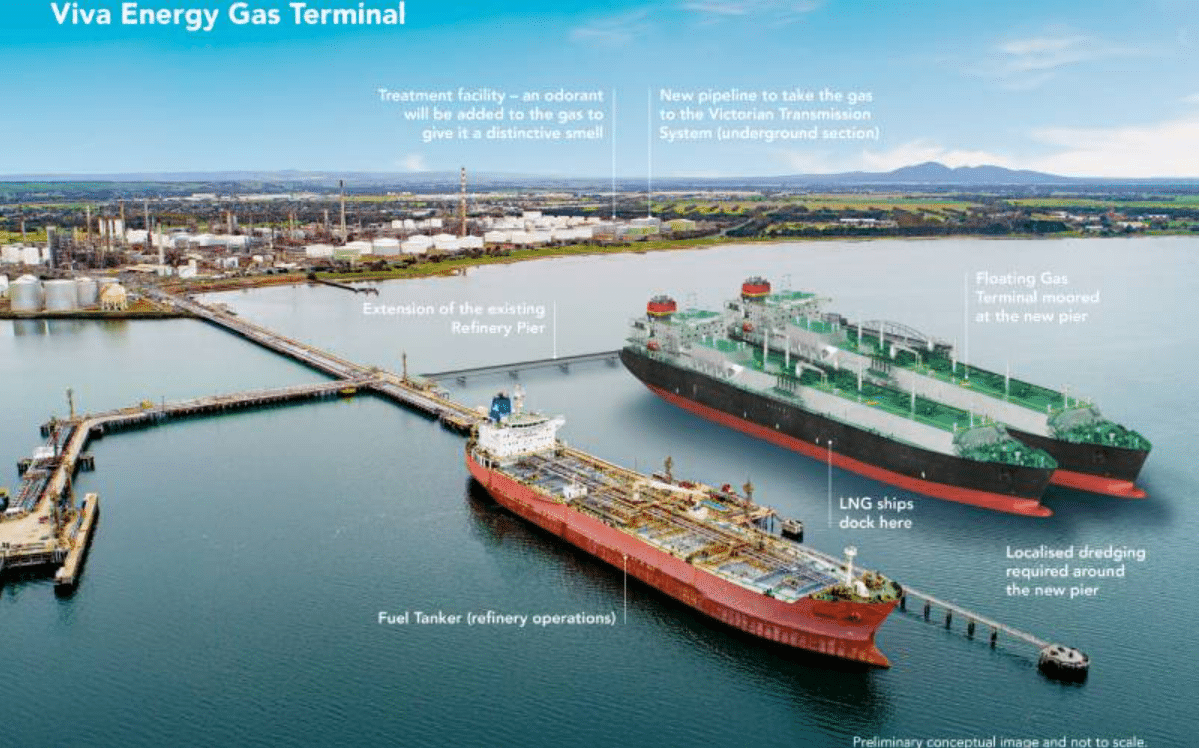
Viva Energy is proposing to build a new gas import terminal in Corio Bay. The project would see a floating storage and regasification unit continuously moored at the new Refinery Pier berth. The terminal would be located in our iconic and beautiful bay area making it eye sore for the majority of views of the bay from Geelong.The project would bring gas from other parts of the country and overseas to supply the south-eastern Australia market, a disaster for our climate. We will also have gas tankers coming and going within kms of schools and communities raising concerns about safety.
At a time when the world is facing a climate emergency, it is crucial to transition away from fossil fuels and invest in sustainable energy solutions.
Right now Victorians are dealing with cost of living pressures on top of an escalating climate crisis, and Viva’s plan to import gas will be terrible for both.
Community Opposition
Our community has strongly campaigned over the past four years, letting the State Government know that our community does not support this disastrous project.
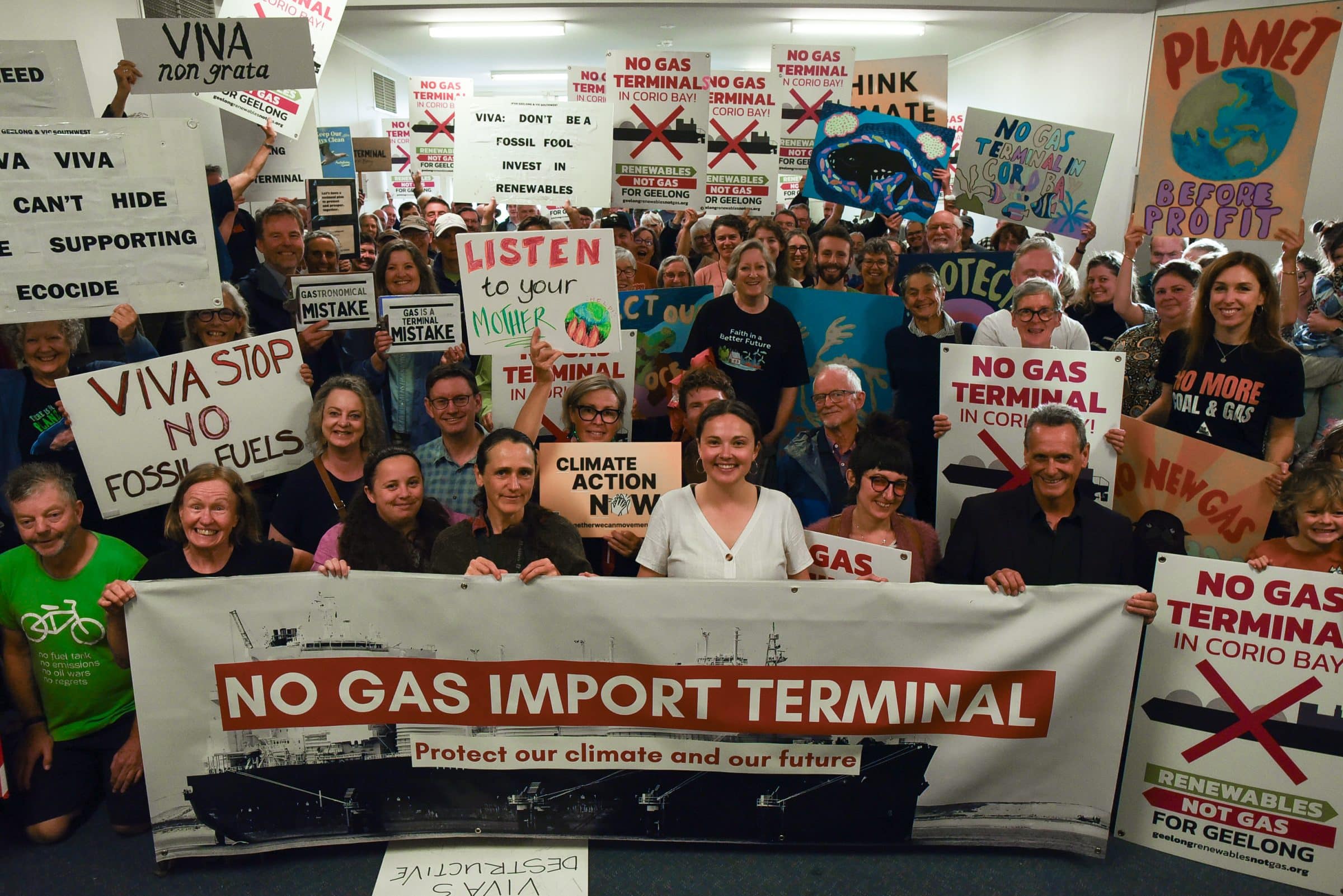
We have sent hundreds of emails, attended significant campaign events, written thousands of submissions, presented at multiple hearings and showed up again and again. We have also led two successful community action events – the Protest Picnic and Protest in the Park, with hundreds of people showing up.
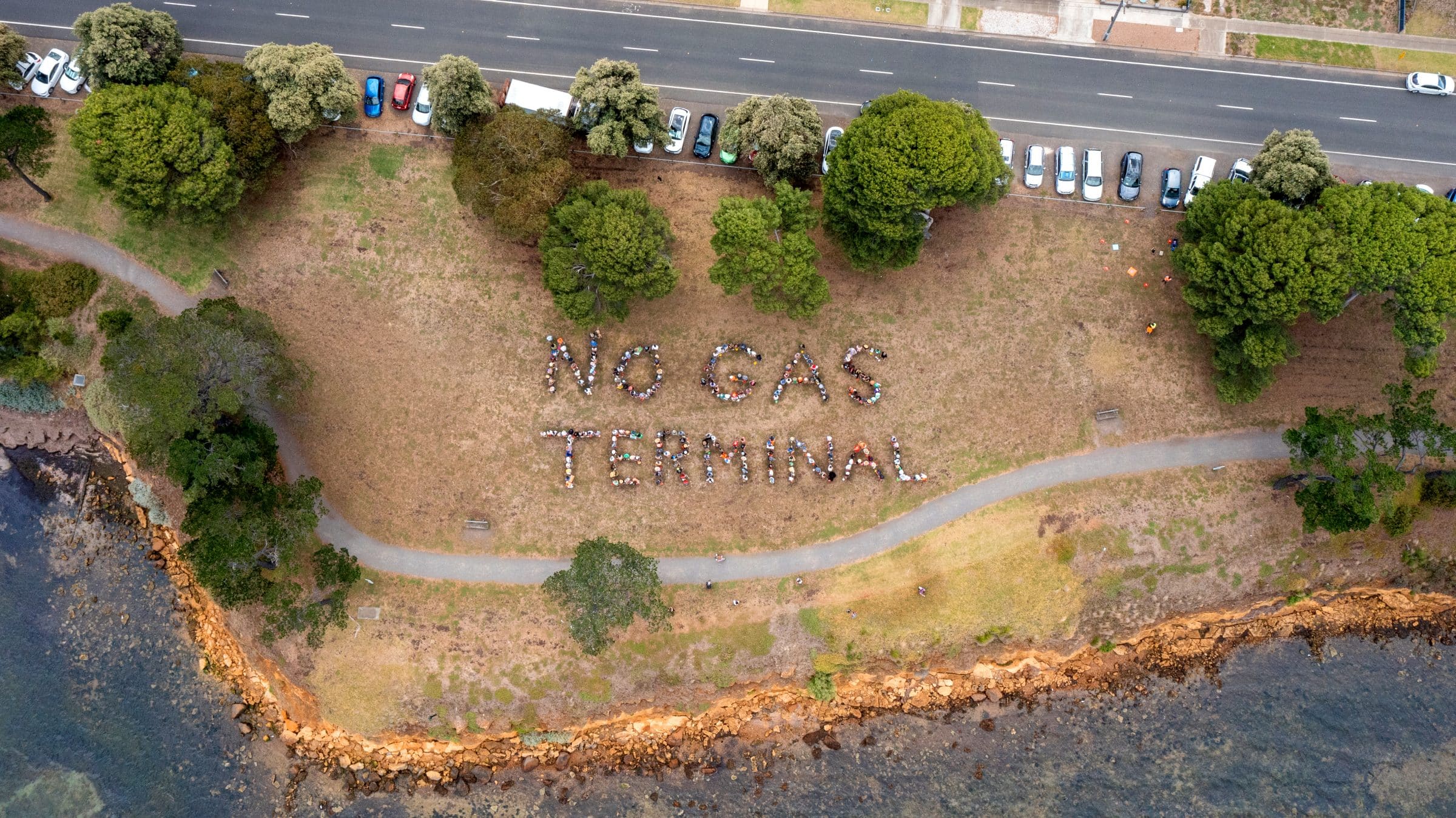
An incredible turnout for the Protest in the Park in early 2025 included the creation of a Human Sign stating ‘No Gas Terminal’ which was covered by multiple media outlets. We also ran a Protest Picnic in late 2024 which gained national attention with ABC News as well as other local media.
If you have been part of the movement, thank you for making your voice heard. The strong community campaign run by Geelong Renewables Not Gas has made, and continues to make, a considerable difference. It has delayed the project and created a number of hurdles to be navigated by Viva. Community strength and action once again has been shown to make an impact and we will continue to put the pressure on.
Why this Project is Problematic
Geelong Sustainability is concerned about a number of factors including the climate impacts, safety concerns, environmental concerns and cultural heritage impacts. The areas of concerns are identified below:
1. This is a disaster for the climate!
The impact of an approved Viva Gas Import Terminal would extend far beyond Geelong, adversely affecting the entire region. This is not just a local issue but a regional one, with far-reaching consequences for climate resilience and climate mitigation. The project’s climate impact is substantial and fundamentally incompatible with Victoria’s emissions targets. Viva Energy estimates that gas delivered via the terminal would account for 12% of Victoria’s 2022 emissions and 34% of the state’s 2035 emissions target. This directly hinders progress toward achieving these goals and promotes continued reliance on fossil fuels.
2. Safety and Navigation Risks
Safety, navigation, and security concerns further underscore why this project is unsuitable for Corio Bay. The proposed site is too close to residential properties (within 220m of North Shore homes), and the Corio Bay shipping channel is not designed to accommodate large LNG carriers safely.
Rival LNG import terminal proponent, Vopak has highlighted the depth and breadth challenges of the channel, likely requiring transit only at high tide and safe anchorage being many kilometres away. Viva Energy has failed to meaningfully engagement with Ports Victoria regarding security and exclusion zones.
- Corio Bay Shipping Channel unsuitable for LNG Carriers (LNGCs): The shipping channel in Corio Bay presents several challenges for the operation of LNGCs, particularly due to its insufficient depth. A typical LNG tanker is approximately 300 metres long and 43 metres wide, with a draft extending 12 metres underwater. The Geelong Channel, however, is only 11.9 metres deep at high tide and 10.6 metres at low tide, making it too shallow for these vessels under normal conditions.
This means that the channel would require significantly more dredging than Viva Energy states in their EES to accommodate LNGCs safely. The combination of the narrow channel width and varying depths leaves minimal room for emergency manoeuvres or safe navigation, especially during low tide, which increases the risk of grounding or other navigational hazards. - LNG Incidents and Community Safety: The findings of Sandia National Laboratories, which conducted comprehensive safety and hazard assessments of LNG transport, highlight the potential for severe public safety hazards from thermal radiation and flammable vapour clouds, with hazard zones extending up to 3,500 metres from a spill site. Viva Energy has not adequately addressed these findings in their risk assessments. The close proximity of the shipping channel to homes in the northern suburbs means more than 30,000 homes are within the incident zones.
How You Can Help
Geelong Renewables Not Gas
Geelong Sustainability is a proud member of the Geelong Renewables Not Gas coalition. Geelong Renewables Not Gas is an alliance of community groups that formed in response to the threat of Viva Energy’s proposed gas terminal. It consists of many community and environment groups, see https://geelongrenewablesnotgas.org/about-us/